Why Dogs Need Other Dogs: The Science of Canine Social Play
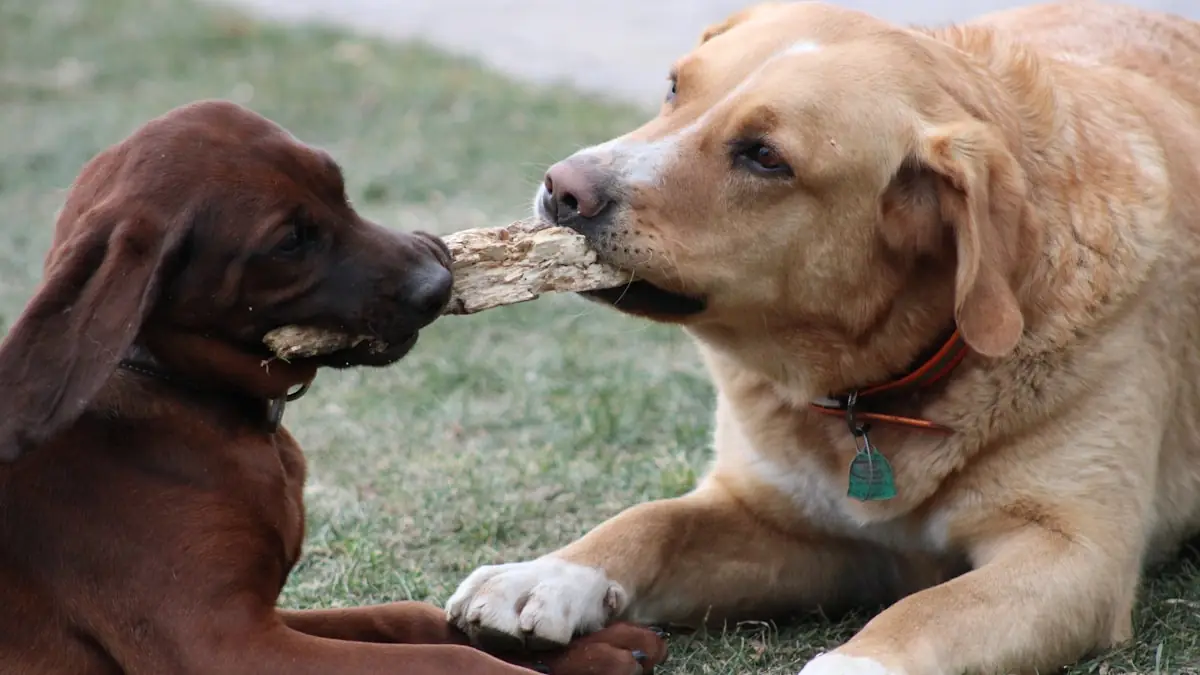
When two dogs chase, body-slam, and gnaw on each other at the park, it looks like chaos, or a fight about to break out. It isn't. Decades of behavior research show canine play is one of the most rule-bound, carefully negotiated things dogs do, and it teaches them skills they use for life: how hard to bite, how to read another dog's signals, how to apologize and keep the game going.
Here's the science of why dogs genuinely need other dogs, and why the right playmate matters far more than the number of them.
Play isn't pointless: what dogs are actually doing
Picture the standard park scene. One dog drops into a crouch, springs sideways, and bolts. Another gives chase, slams a shoulder into it, and the two collapse into a tangle of open mouths and legs. Someone briefly mounts someone else. To a nervous owner it can read as a brawl in the making.
It almost never is. Ethologists treat this as social play, a distinct, voluntary behavior category that borrows movements from fighting, hunting, and mating but stitches them together in an exaggerated, repetitive, out-of-order way that signals "none of this is for real." The give-away is how rarely it tips over: in observational work at off-leash dog parks, the overwhelming majority of play bouts resolve without any genuine conflict at all.
That reframes the whole thing. Play isn't filler or wasted energy. It's functional learning, and unlike a lot of dog-development talk, it doesn't shut off after puppyhood. The skills below are practiced in the first months of life, then maintained, dulled, or lost depending on how much a dog keeps playing as an adult.
Bite inhibition: how play teaches dogs to control their mouths
Bite inhibition is a dog's learned ability to control jaw pressure, so that even when a mouth lands on skin or fur, the bite doesn't cause real damage. It is arguably the single most important safety skill a dog can have, and dogs mostly learn it from other dogs.
The mechanism is a simple feedback loop. A puppy mouthing a littermate clamps down too hard. The littermate yelps and the game stops cold. Repeat that a few dozen times and the lesson lands: bite that hard and the fun ends. So the puppy dials it back, and over weeks the dog calibrates a soft, controlled mouth.
Humans can reinforce this, but littermates and peers are the natural classroom. The most receptive window sits inside the broader socialization period, roughly the first few months, and it keeps getting tuned through ongoing play with other dogs. That's a big part of why dogs that grow up with normal peer play tend to have gentle mouths.
The payoff is safety. A dog with good bite inhibition who is startled, hurt, or pushed past its limit and snaps is far less likely to do serious harm than a dog that never learned to pull its punches. It's the difference between an air-snap and a trip to the emergency room. This is also why poorly socialized dogs are a problem worth taking seriously: behavioral issues, not infectious disease, are the number one cause of death for dogs under three years of age, and dogs that miss out on early social exposure carry a higher lifelong risk of fear, avoidance, and aggression.
A whole language: how dogs negotiate play fairly
If play uses fight-and-bite moves, why doesn't it constantly turn into a fight? Because dogs run it on an honest signaling system, and they hold each other to the rules.
The play bow
The opening move is the play bow: front legs down, rear up, tail wagging, a bouncy version of a stretch. It's one of the most stereotyped signals in the dog repertoire, and it functions like a header on everything that follows: what I'm about to do is play, not aggression. A growl after a bow means something different than a growl on its own.
And dogs trust it. Behavioral ecologist Marc Bekoff found that even when a play bow was followed by what looked like rough stuff, baring teeth, growling, or biting, companions responded with submission or avoidance only around 15% of the time. They keep playing, because the bow told them the bite was in fun.
Self-handicapping and role reversal
Fairness gets enforced through two moves. In self-handicapping, a bigger or stronger dog holds back, biting softer than it could and running slower than it can, so a smaller partner stays in the game. In role reversal, the dog that "should" win takes turns losing: a confident dog flops onto its back, or lets the smaller dog pin it and chase it.
These aren't just charming; across canids the stakes are real. Bekoff and Jessica Pierce note that juvenile coyotes that don't play fair often end up leaving their pack and are up to four times more likely to die than those that stay. Playing by the rules is, quite literally, a survival skill.
Admitting fault
When play gets too rough by accident, dogs have a repair move: they re-bow. A quick second bow after an over-the-top moment works like an apology, a reset that says "still just playing, let's keep going." It's a small thing that reveals how much intention sits under the wrestling.
Put it together and play is where dogs become fluent in the language they'll use for life. A dog that can read a bow, a stiffening spine, or a turned head, and adjust, defuses tension before it becomes a fight. To get better at reading those same signals yourself, our guide to telling play from a real fight breaks them down.
More than skills: bonding, stress relief, and mental work
Play isn't only a training ground for motor skills and signals. It also builds relationships. Dogs that play together tend to get along better, and a good session lowers tension between them rather than raising it.
There's an enrichment angle too. A solo chew toy or a walk around the block is predictable; a live partner is not. Another dog is unscripted, responsive, and constantly changing the game, which makes social play one of the harder forms of mental stimulation to replace with anything you can buy. For how this fits alongside walks and other activity, see how much exercise a dog actually needs.
The welfare research points the same way. In one shelter study, dogs given 25-minute sessions pairing exercise with positive human contact showed lower salivary cortisol and better behavior-test scores (Menor-Campos et al., Veterinary Record, 2011), evidence that exercise plus friendly contact measurably reduces stress. And none of this expires: adult and senior dogs still benefit from appropriate social outlets, even if the romps get shorter and slower with age.
It's not just for puppies: socialization is lifelong
The puppy window is real and it matters. The most receptive period for soaking up new experiences runs roughly 3 to 14 weeks of age, the highest-leverage time to introduce a puppy to other dogs, people, and places.
The myth is that the job is done at four months. It isn't. The AVMA frames socialization as a lifelong process and advises owners to keep rewarding calm or playful responses to social interactions throughout a dog's life. Skills fade without use. A dog that stops meeting other dogs can get rusty, wary, or reactive over time, not because anything is wrong with it, but because the practice stopped.
That early exposure leaves a measurable mark. A research review in Veterinary Medicine: Research and Reports found that early social and environmental exposure is positively correlated with sociability and negatively correlated with fear and aggression, with puppies that attended socialization classes turning out less fearful, less aggressive, and more social. (The review is careful to note that evidence for class attendance specifically, as opposed to good home socialization, is mixed, so it's the exposure that does the heavy lifting, not the venue.)
The reassuring flip side: if you've adopted an adult dog with a patchy social history, you haven't missed the boat. Careful, gradual, positive social exposure still helps. It just asks for more patience and better matchups.
Quality over quantity: the right playmate beats more playmates
Here's the nuance that gets lost at a busy park. More dogs is not better. Better-matched dogs is better. A handful of good-fit play partners does far more good than a crowded, mismatched free-for-all.
A good fit means compatible size, energy, and play style, and play that's mutual: both dogs take turns chasing and being chased, both self-handicap, both take breaks. A 70-pound adolescent and a timid 8-pound senior are rarely a fair match, no matter how friendly everyone is.
Learn to read the difference:
| Green flags (keep going) | Red flags (intervene) |
|---|---|
| Loose, wiggly bodies | Stiff, frozen postures |
| Bouncy, exaggerated movement | One dog only chasing, never chased |
| Self-handicapping and role reversal | One dog steamrolling, never letting up |
| Frequent pauses and re-bows | No breaks; play that keeps escalating |
| Both dogs choosing to re-engage | One dog repeatedly trying to leave |
A bad or overwhelming experience doesn't just fail to help, it can set socialization backward, especially for puppies and sensitive dogs. One pile-on from a crowd of pushy dogs can teach a young dog that other dogs are scary, the opposite of the goal. Your job isn't to maximize raw exposure; it's to supervise, advocate for your dog, and curate the matchups, breaking things up before a mismatch becomes a memory.
Putting it into practice
The practical version is simple: prioritize known, well-matched playmates and supervised, low-pressure settings over chaotic crowds.
- Aim for quieter hours. Off-leash parks at off-peak times, small playdates, and standing groups of familiar dogs beat peak-hour mobs for most dogs. If you're heading to a public park for the first time, our first-trip checklist covers the etiquette.
- Read your individual dog. Some are social butterflies who want a dozen friends. Some want one or two trusted buddies and find a packed park stressful. Both are normal. Don't force a one-or-two-friends dog into a crowd because you think it "should" be more social.
- Mind the timeline for puppies. When a young dog is ready to join group play depends on age and vaccinations, covered in when a puppy can go to the dog park.
This is exactly the problem the Off Leash app is built for: instead of rolling up and hoping for a good crowd, you can see which dogs are checked in right now in Vancouver and NYC, find compatible playmates, and pick a quieter time when the mix suits your dog. Finding the right dogs to play with, not just the most of them, is the whole point.
Chase, wrestle, and gnaw away. Underneath the chaos, your dog is doing exactly what it was built to do.
Sources
- AVSAB Position Statement on Puppy Socialization — American Veterinary Society of Animal Behavior (AVSAB)
- Socialization of dogs and cats — American Veterinary Medical Association (AVMA)
- When Dogs Play, They Follow the Golden Rules of Fairness — Psychology Today (Marc Bekoff, Ph.D.)
- For a Model of Fair Play, Look to Dogs — Scientific American (Marc Bekoff & Jessica Pierce)
- Puppy parties and beyond: the role of early age socialization practices on adult dog behavior — Veterinary Medicine: Research and Reports (PMC / NIH)
- Effects of exercise and human contact on animal welfare in a dog shelter (Menor-Campos et al.) — Veterinary Record (via PubMed)