Play or Fight? Reading Dog Body Language at the Park
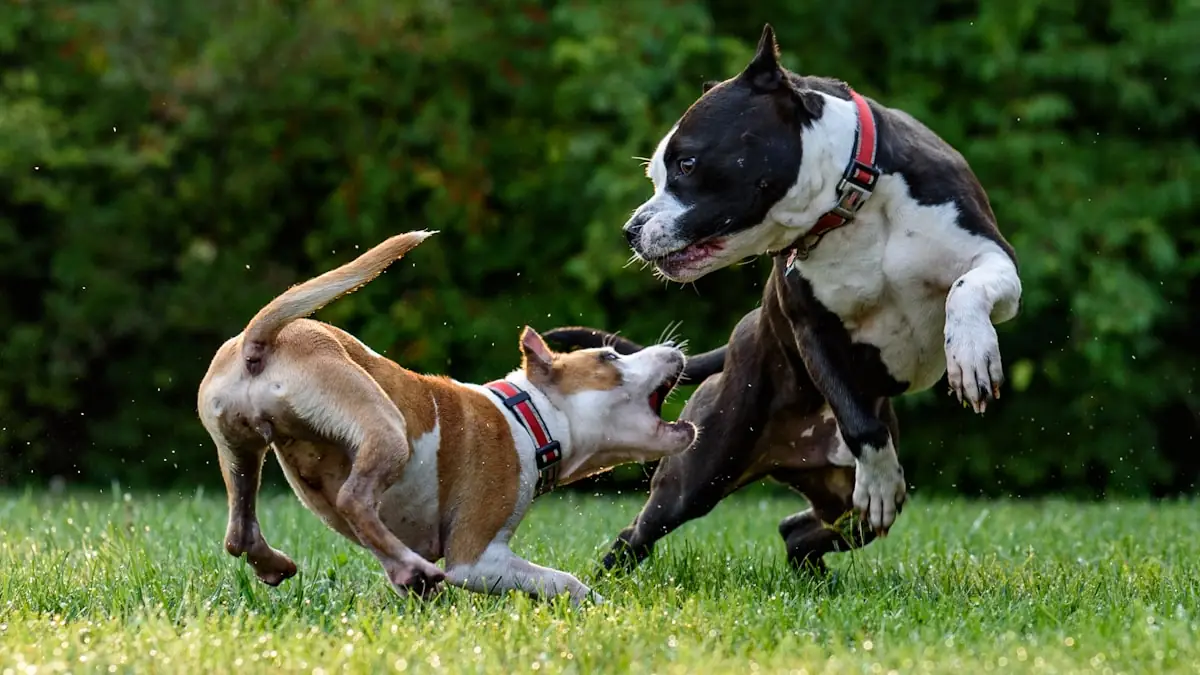
A blur of teeth, a body slam, a chase that suddenly looks too fast: every dog-park moment forces the same split-second question. Is this happy play, or is it about to tip into a fight?
The good news is that dogs telegraph the answer constantly. Once you know the handful of signals to watch, you can read a romp like a sentence and step in a beat before trouble starts.
The one rule that decides everything: loose vs. stiff
If you remember nothing else, remember this: a loose, wiggly, bouncy body means play; a body that goes stiff, frozen, and still means stop and watch.
No single body part tells the whole story. Veterinary behaviorists are clear that you have to read the entire dog, because the same signal can mean different things in different contexts. A wagging tail, for example, only tells you the dog is emotionally aroused, not that it's friendly: a slow, sweeping wag suggests a relaxed dog, while a fast, twitchy wag points to a higher level of arousal, possibly in a negative way.
This matters because good play looks alarming. Dogs growl, slam into each other, bare their teeth, and open their mouths wide. That roughness is normal, so "it looks intense" is a useless filter. The better filter is the transition: the exact moment a relaxed, bouncy body shifts to tense and frozen is your warning, not the noisy wrestling itself.
The green flags: what real play looks like
Healthy play has a signature. Learn the pieces and the picture comes together fast.
- The play bow. Chest down, rump up, tail high and waving. It's the universal "this is play" invitation. Peer-reviewed research on dog puppies found that play bows function mainly to re-initiate and reposition play after a pause rather than to clarify confusing signals or to set up a sneak attack. When a dog drops into a bow mid-game, it's asking to keep going.
- Loose, swishy bodies. Soft, blinky eyes, open relaxed mouths, bouncy exaggerated movements, and big helicopter tail wags. Everything looks elastic rather than coiled.
- Self-handicapping. A bigger or stronger dog deliberately holds back, rolls onto its back, or lets a smaller dog "win." Larger or more skilled dogs adjust their strength and speed to keep things fair.
- Role reversal and turn-taking. Dogs swap chaser and chased, top and bottom. No one stays in control the entire time.
- Natural pauses. Healthy play has frequent micro-breaks. Dogs stop, shake off, sniff the ground, then choose to re-engage. The pauses are a feature, not a lull.
If you're still building your eye for this, why dogs need to play with other dogs covers what good social play does for them in the first place.
The red flags: when play tips toward trouble
Trouble usually announces itself a beat early. The classic precursor is the one most people miss.
Stiff freezes and body stillness. A dog that suddenly holds itself rigid and motionless is the warning sign owners overlook most. According to the American Veterinary Society of Animal Behavior, a dog holding his body stiff and still is more likely to snap, growl, or bite if the other dog keeps trying to engage. Body stillness, in their words, is a commonly overlooked characteristic of canine communication.
The hard stare. A tense, fixed gaze locked on the other dog is, per the same source, the face you might see right before aggression. Contrast it with the soft, blinking eyes of a dog that's enjoying itself.
Whale eye. When a dog turns its head away but keeps tracking something with its eyes, you see a lot of white around the outside of the eye—the sclera. That's a tension signal, not a quirky look.
Raised hackles. The strip of fur standing up along the spine, called piloerection, is real but widely misread. It's a definite sign the dog is aroused, but not necessarily in a negative way. The dog might be stressed or upset, but it could also be excited or intensely interested. Treat hackles as a prompt to check the rest of the body, not a verdict.
A tail held high and stiff, or wagging fast and twitchy, paired with a tight closed mouth or a wrinkled muzzle. The higher and more rigid the tail, the more assertive the dog; a tucked tail signals fear.
Mismatch and pursuit. One dog repeatedly trying to flee, hide, or escape while the other keeps chasing, or one dog pinning or cornering another that cannot get away. Play needs an exit for both dogs. When one dog has lost that exit, it isn't play anymore.
The calming signals most owners miss
Before a dog gets loud, it gets quiet. These small signals are the polite "I need a break" messages that come before the snap.
- Lip-licking and yawning out of context. Not after a nap or a meal, but mid-interaction. These can be early signs of stress, particularly when paired with a tight mouth and an averted gaze.
- Looking away or turning the head and body away. A deliberate request to dial things down.
- Shake-offs, ground-sniffing, slowing down, and approaching in a curve rather than charging head-on. These are the small resets dogs use to take the pressure off.
A dog sending these signals is asking for space. The idea of reading these quiet cues was popularized by Norwegian trainer Turid Rugaas under the name "calming signals," and her work is a worthwhile next read if you want to go deeper. The practical takeaway: the dog sending them needs an exit, and the other dog—or you—should give it one.
The consent test: proof that play is mutual
When you're not sure both dogs are enjoying it, you don't have to guess. There's a simple test.
- Gently hold or pull one dog back for a few seconds.
- Let go.
- Watch what the released dog does.
If it runs straight back to re-engage, the play was consensual—both dogs were in. If it shakes off, sniffs the ground, wanders away, or goes to visit the people, that dog wanted out and was tolerating rather than enjoying the game.
Run the test any time one dog seems to be doing all the chasing or pinning, or whenever you're unsure. The underlying principle is the heart of safe play: either dog should be able to pause or leave without being chased or pressured. If that's not true, it's time to step in.
Arousal, overstimulation, and when to step in
Good play breathes. When it stops breathing, arousal climbs.
The clearest warning is no pauses. When a game runs several minutes straight with no natural breaks, the dogs are winding each other up and a reset is overdue. Other escalation cues include mounting, frantic vocalizing, ignoring a playmate's calming signals, and a group ganging up on one dog.
How to intervene without making it worse:
- Call the dogs apart calmly. Use a recall or a body block to put space between them.
- Give them a break. A short pause often resets arousal and lets play resume in a healthier register, or end cleanly.
- Never reach between two dogs or grab a collar mid-conflict. That's how owners get bitten.
Manage your own dog proactively. Take breaks before things peak, and if your dog is overwhelmed—or is the one doing the overwhelming—leash up and leave. Calling it early is not failure; it's the whole skill. If your dog is new to all this, a calm first trip to the dog park sets the tone, and puppies in particular benefit from short, low-key sessions.
Read the room before you arrive
A lot of bad play is really a bad matchup—a high-drive bruiser turned loose on a cautious senior, or a crowd so big no one can take a breath. The fix often starts before you leave the house.
This is where checking ahead helps. With the free Off Leash app you can see which dogs are already checked in at off-leash parks across Vancouver and New York City, so you can pick a quieter time or a better size and play-style match for your dog. Less crowding and smarter matchups mean calmer play and fewer of the mismatches that tip a romp into a scuffle.
Read the body in front of you, trust the loose-versus-stiff rule, and give every dog an easy way out. Do that, and most of the hard calls make themselves.
Sources
- Understanding Canine Facial Expressions and Body Postures — American Veterinary Society of Animal Behavior (AVSAB)
- Understanding Dog Body Language: Decipher Dogs' Signs & Signals — American Kennel Club (AKC)
- Investigating the Function of Play Bows in Dog and Wolf Puppies — PLoS ONE / National Library of Medicine (PMC)
- 7 Tips on Canine Body Language — ASPCApro (ASPCA)
- How to Tell If Dogs Are Playing or in Conflict — Camp Bow Wow